





EV Charger Installation in Cincinnati and Northern Kentucky
An EV charger is a critical electrical installation. Done right, it keeps your vehicle, your charger and your home’s electrical system safe for years. Cooper Electric installs home and commercial EV chargers across Greater Cincinnati and Northern Kentucky, so you can reliably charge into the future.
Electric vehicle chargers go by many names: EVSE (electric vehicle supply equipment), EV chargers, EV circuits, charging docks or charging stations. Whatever you call it, our licensed electricians make sure your charger gets the right power, the right circuit and a code-compliant installation.
EV Charger Brands We Install
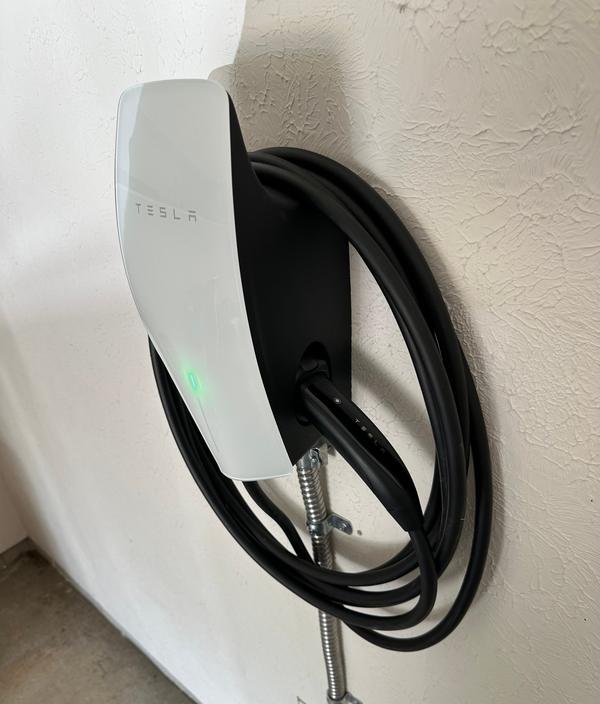
Featured install
Tesla Universal Wall Connector
One charger for every EV in your garage. Tesla’s Universal Wall Connector charges Tesla and non-Tesla vehicles alike, with a built-in J1772 adapter and a 24-foot cord.
- Charges Tesla and non-Tesla EVs
- Built-in J1772 adapter and 24-foot cord
- Installed on a dedicated circuit by our licensed electricians
- ChargePoint Home Flex
- Tesla Wall Connector and Universal Wall Connector
- Lectron Level 2
- Quasar 2
Home EV Charging: Why Level 2
Most EV owners choose a Level 2 charger because it charges about 5 times faster than a standard outlet. A Level 2 charger on 240 volts adds about 25 miles of range per hour, while Level 1 on 120 volts adds only about 4 miles per hour (source: ChargeHub home charging guide). Driving a plug-in hybrid or extended-range EV? See how Level 2 charging applies to your vehicle.
- Most vehicles get a full charge overnight in about 4 to 6 hours
- Smart chargers let you schedule charging for off-peak hours and view your charging history from a phone app
- Hardwired models mount to the wall; plug-in models can be moved occasionally
- Some chargers handle cold weather and outdoor locations better than others. Most chargers we install go inside the garage, out of the elements
Plug-In Hybrids and Extended-Range EVs: What Plugging In Gets You
Plug-in hybrids (PHEVs) and extended-range electric vehicles (EREVs) both have a charge port and a gas tank, but they use the power from your outlet very differently. In both, the only miles you get from plugging in are the miles stored in the battery. How quickly your home circuit can refill that battery decides how much of your driving runs on electricity instead of gas.
The Cord Is Not the Charger
The charging cord that comes with the vehicle, and the wall unit we install, is technically called EVSE: a smart safety switch. It delivers AC power from your panel and tells the vehicle how many amps the circuit can safely supply. The actual charger is built into the vehicle. Its onboard charger converts that AC power to DC to fill the battery. Charging speed is set by whichever is smaller: the circuit and EVSE, or the vehicle’s onboard charger.
- Level 1 cord: 120 volts from a standard outlet, about 12 amps, roughly 1.4 kW
- Level 2: 240 volts on a dedicated circuit, typically 3.3 kW up to 11 kW or more, depending on the circuit and the vehicle
Plug-In Hybrids (PHEV)
A plug-in hybrid has a gas engine that can drive the wheels, plus a relatively small battery that typically covers about 20 to 50 miles of electric driving. When the battery is used up, the vehicle keeps going as a regular hybrid. Many PHEVs have onboard chargers of only 3.3 to 7.2 kW, so they can’t use the full output of a large Level 2 charger (source: Lectrium).
- On Level 1: most PHEVs refill overnight, but a battery drained during the day may not be full again until the next morning
- On Level 2: the full electric range usually comes back in a few hours, so a quick top-off between errands adds more electric miles to the same day
Extended-Range EVs (EREV)
An EREV is driven by electric motors. Its gas engine works mainly as a generator, making electricity when the battery runs low. EREVs carry much larger batteries than plug-in hybrids. Ram’s 1500 Ramcharger, for example, uses a 92 kWh pack with a V6-powered generator (source: Automotive Fleet). That big battery is what lets an EREV cover most daily driving on electricity alone, but only if it gets recharged.
- On Level 1: a 120-volt cord adds only a few miles of range per hour, so refilling a large EREV battery from empty can take days
- On Level 2: the battery can be refilled overnight, so the generator becomes a backup for long trips instead of an everyday necessity
| Plug-in hybrid (PHEV) | Extended-range EV (EREV) | |
|---|---|---|
| What turns the wheels | Gas engine and electric motor | Electric motors; gas engine mainly makes electricity |
| Battery size | Small | Large |
| Range from plugging in | About 20 to 50 miles | Most daily driving |
| Level 1 (120V) | Usually workable overnight | Too slow for daily use |
| Level 2 (240V) | Faster top-offs between trips | Essential for a full overnight charge |
Sizing the Circuit to Your Vehicle
Before we install a Level 2 charger, we check your vehicle’s onboard charger rating and your electrical panel’s capacity. A plug-in hybrid with a 3.3 kW onboard charger doesn’t need the same circuit as an EREV or a full EV. Sizing it correctly can avoid an unnecessary panel upgrade, and if you plan to go fully electric later, we can wire for that now.
Commercial EV Charging
For businesses, multifamily properties and fleets, our commercial and industrial team designs and installs EV charging, including any electrical service upgrades needed to support it. Higher-power chargers can require three-phase power and significantly larger electrical service.
Charger Levels at a Glance
- Level 1: 120 volts, typically 12 to 20 amps
- Level 2: 240 volts, typically 40 to 80 amps
- Level 3 (DC fast charging): three-phase 480-volt power, which can require 400 amps or more
EV Charger Installation Checklist
- Available electrical capacity, preferably a 200 amp service. A Level 2 charger can use as much power as a large electric oven or more: 50 amps x 240 volts = 12,000 watts (12 kW)
- Space in your panel for a 2-pole breaker
- The route and distance from your panel to the charger location
- The best location for the charger in your garage or driveway
- Hardwired installation (preferred), or a NEMA 14-50 or NEMA 6-50 outlet for plug-in chargers
Frequently Asked Questions
Will I need a panel upgrade for an EV charger?
Not always. It depends on your service size, how much capacity is already in use and whether there is space for a 2-pole breaker. A 200 amp service is preferred. Send us a photo of your panel and we can tell you what is needed.
Should my charger be hardwired or plugged in?
We prefer hardwired installations. If you want a plug-in charger, we can install a NEMA 14-50 or NEMA 6-50 outlet.
Do you install chargers through Qmerit or Electrum?
Yes. Cooper Electric is a preferred installation provider for both Qmerit and Electrum in Greater Cincinnati.
Get your EV charger installed
Tell us your vehicle and charger, or send a photo of your panel, and we will recommend the right setup.
Cincinnati: 513-271-5000 Northern Kentucky: 859-341-1550 Request Service Online
5-Star Reviews on Google by hundreds of local customers. Read our Google reviews
Licensed electrical contractor in Ohio (OCILB #20022) and Kentucky (#CE16472). Serving Greater Cincinnati and Northern Kentucky since 1946.
Qmerit and Electrum Preferred Provider
Cooper Electric is a preferred EV charger installation provider for both Qmerit and Electrum in the Greater Cincinnati area.