
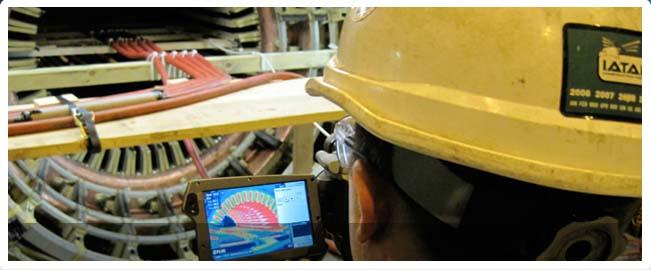
Megger Insulation Resistance Testing in Cincinnati
Insulation is what keeps electricity where it belongs. Heat, moisture, dirt, vibration and age wear it down slowly and invisibly, until a motor shorts, a cable faults or a transformer fails. A Megger insulation resistance test measures the health of that insulation, so you can repair or replace equipment on your schedule instead of after a failure.
What Is a Megger Test?
“Megger” is the name commonly used for an insulation resistance test, after the instrument brand that made it famous. The tester applies a steady DC voltage, higher than the equipment sees in normal service, between a conductor and ground or between conductors, and measures the tiny current that leaks through the insulation. The result is shown in megohms (millions of ohms). High readings mean healthy insulation; low or falling readings mean moisture, contamination or breakdown.
Defective or inadequate insulation is one of the leading causes of electrical failures, and moisture, which also attacks insulation, is another. Insulation resistance testing is one of the few ways to see both coming.
What We Test
- Motors and generators: stator windings, including polarization index testing
- Cables and feeders: phase-to-ground and phase-to-phase, before energizing and during maintenance
- Transformers: winding-to-winding and winding-to-ground insulation
- Switchgear, switchboards and bus duct: bus insulation and supports
- Circuit breakers: pole-to-pole, pole-to-ground and across open contacts
- New installations: acceptance testing before equipment is placed in service
The Tests We Perform
| Test | What it tells you |
|---|---|
| Spot insulation resistance | A one-minute reading, recorded and compared with past results and with similar equipment |
| Polarization index (PI) | The ratio of the 10-minute reading to the 1-minute reading. A low ratio points to moisture or contamination in motor and transformer windings |
| Dielectric absorption ratio (DAR) | A shorter version of the PI, comparing the 60-second and 30-second readings |
| Step voltage | Readings at increasing test voltages. Readings that drop as voltage rises reveal cracks, aging and weak spots |
| Hi-pot (high potential) | A higher-voltage proof test for cables and equipment, through Cooper Power Services |
We choose the test voltage for each piece of equipment from its voltage rating, following industry (NETA and IEEE) guidance, and correct readings for temperature so this year’s results can be compared fairly with last year’s.
Why Trending Matters
A single reading tells you whether insulation passes today. A series of readings, taken the same way each year, tells you where it is headed. A motor whose insulation resistance drops sharply from one year to the next can be dried out, cleaned or rewound during a planned shutdown, instead of failing in the middle of a production run. We record every result so you can see the trend.
When to Test
- As part of your annual or periodic preventive maintenance program
- Before putting new or repaired equipment into service
- Before re-energizing equipment after flooding, a roof leak, a fire or a long shutdown
- When a motor trips, runs hot or has been sitting idle in a damp area
- When troubleshooting ground faults or nuisance tripping
Done Safely
Insulation resistance testing is performed on de-energized, locked-out equipment, and the test voltage itself must be handled with care. Our electricians follow NFPA 70E safe work practices, verify the absence of voltage before testing, and discharge equipment afterward. We schedule testing during planned shutdowns, weekends or off-shifts to keep your operation running.
Frequently Asked Questions
What is a good Megger reading?
It depends on the equipment, its voltage rating, its size and the temperature at the time of the test. Industry tables give minimum values, but the most useful comparison is against the same equipment’s earlier results. A steady reading is good; a sudden drop needs attention even if it still passes.
What is a good polarization index?
For most modern motor and generator windings, IEEE Standard 43 recommends a polarization index of at least 2.0. Lower values usually mean moisture or contamination in the windings.
Will the test damage my equipment?
No. When the right test voltage is chosen for the equipment’s rating, insulation resistance testing is non-destructive. Electronics such as drives, PLCs and surge protectors are disconnected or isolated first.
How is this different from infrared thermography?
Infrared finds heat in energized equipment, mostly from bad connections and overloads. Insulation resistance testing finds weak insulation in de-energized equipment, which usually does not show up as heat until it fails. The two work best together.
Schedule Megger insulation testing
Call us to test motors, cables, transformers or switchgear, or to add insulation testing to your maintenance program.
Cincinnati: 513-271-5000 Northern Kentucky: 859-341-1550 Request Service Online
5-Star Reviews on Google by hundreds of local customers. Read our Google reviews
Licensed electrical contractor in Ohio (OCILB #20022) and Kentucky (#CE16472). Serving Greater Cincinnati and Northern Kentucky since 1946.