Power Quality Analysis in Cincinnati
Drives that trip for no reason. PLCs that lock up. Transformers and neutrals running hot. Lights that flicker when a big motor starts. These are power quality problems, and they cost manufacturers and commercial buildings real money in downtime, scrap and failed equipment. Cooper Electric’s Certified Power Quality Professionals find the cause and fix it.
Signs You Have a Power Quality Problem
- Variable frequency drives, PLCs or computers tripping, faulting or resetting
- Breakers tripping with no apparent overload
- Transformers, neutrals or panels running hotter than their load explains
- Motors running hot or failing early
- Flickering or dimming lights when equipment starts
- Electronics and power supplies failing more often than they should
- Power factor penalties on your utility bill
What We Measure
| Problem | Common causes | What it does |
|---|---|---|
| Voltage sags and dips | Large motor starts, utility faults, undersized feeders | Drives and controls drop out; production stops |
| Swells and overvoltage | Load shedding, capacitor switching, utility issues | Stress on insulation and electronics |
| Transients and surges | Lightning, utility and capacitor switching, motors and welders | Damaged electronics and drives, data errors |
| Harmonics | VFDs, LED drivers, UPS systems, computers and chargers | Overheated transformers and neutrals, nuisance trips |
| Voltage imbalance | Uneven single-phase loads, a failing connection | Motors overheat and lose life |
| Low power factor | Lightly loaded motors and inductive loads | Utility penalties and wasted capacity |
| Grounding and bonding problems | Missing, loose or improper grounds | Noise, shock hazards, equipment malfunction |
How a Power Quality Study Works
- Interview and walk-through. We learn what is failing, when it happens and what changed, and review your one-line diagram.
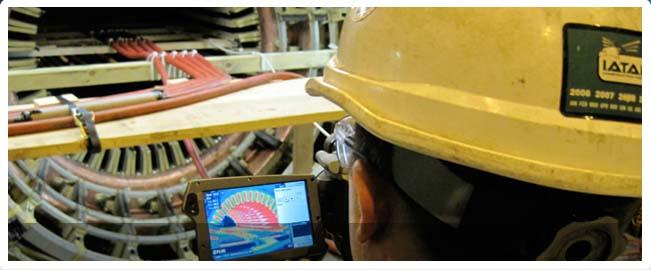
- Install recording analyzers. We connect power quality analyzers at the service entrance and at the problem equipment, with no shutdown in most cases.
- Record through a full cycle. We typically record for about a week, to capture every shift, start-up and weekend.
- Analyze. We match events in the data with the problems you are seeing and compare harmonic levels with IEEE 519 limits.
- Report and recommendations. You receive clear findings and a prioritized list of fixes.
- Fix it. Our licensed electricians install the solution, then we can measure again to prove it worked.
Solutions We Install
- Surge protective devices at the service, distribution panels and sensitive equipment
- Power factor correction capacitor banks
- Line reactors and harmonic filters for variable frequency drives
- Dedicated circuits, isolation transformers and properly sized neutrals for sensitive loads
- Grounding and bonding corrections
- Load balancing and feeder upgrades
- Tightening and repairing connections found by infrared inspection
Certified Power Quality Professionals
Power quality data is easy to collect and easy to misread. Cooper Electric project managers Ted Wright and Chris Flannery are Certified Power Quality Professionals, and Ted and Chris both bring decades of industrial electrical experience. They know how plants run, not just how the meter works, and our licensed electricians install the fix. Meet our team.
Frequently Asked Questions
Can power quality problems come from the utility?
Sometimes. Sags, swells and transients can come from the utility grid. Far more often, though, the source is inside the building: motor starts, drives, welders, capacitor switching or wiring problems. Recording at the service entrance shows which side of the meter the problem is on.
Do you need to shut down to install the analyzers?
Usually not. Most analyzers connect with clamp-on current probes and voltage leads at existing panels while equipment stays energized, working under NFPA 70E safe work practices.
What are harmonics?
Harmonics are distortions in the normal 60 Hz waveform, created by electronic loads such as drives, LED lighting, UPS systems and computers. They add heat to transformers, neutrals and motors, and can cause breakers and electronics to misbehave. IEEE 519 sets recommended limits for harmonic distortion.
Will fixing power factor lower our electric bill?
If your utility charges for low power factor or for kVA demand, correcting it can lower those charges. A power quality study shows your actual power factor and how much correction you need, so the capacitor bank is sized right.
Talk to a Certified Power Quality Professional
Tell us what is tripping, failing or running hot, and we will set up a power quality study to find the cause.
Cincinnati: 513-271-5000 Northern Kentucky: 859-341-1550 Request Service Online
5-Star Reviews on Google by hundreds of local customers. Read our Google reviews
Licensed electrical contractor in Ohio (OCILB #20022) and Kentucky (#CE16472). Serving Greater Cincinnati and Northern Kentucky since 1946.